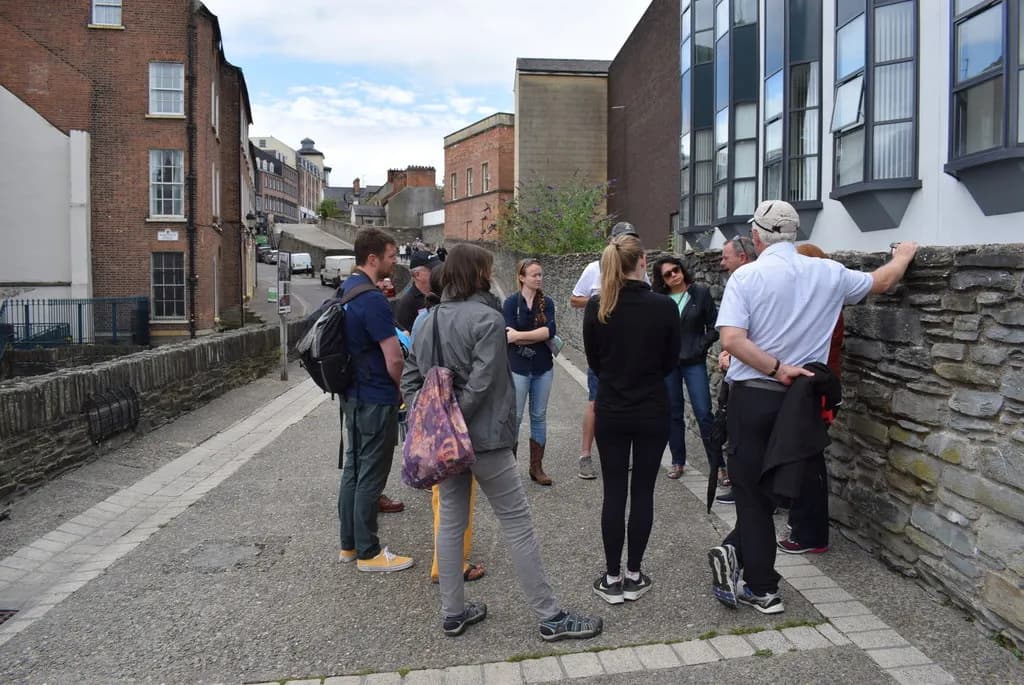
Derry's seventeenth-century walls continue to define the city's character more than four centuries after their construction. At approximately 1.5 kilometres in circumference, they form the most complete urban fortification in Ireland and rank among the finest examples of walled cities anywhere in Europe.
A Fortification That Never Fell
The walls were constructed between 1613 and 1618 by the Honourable the Irish Society, established by the City of London livery companies to colonise and develop the area. Built as a defensive structure during the Plantation of Ulster, they withstood multiple sieges, most notably the 105-day Siege of Derry in 1689. The walls were never breached, earning the city its enduring nickname: the Maiden City.
Unlike many fortified cities across Europe where walls were dismantled as military technology advanced, Derry's walls remained largely intact. The structure includes seven gates: Bishop's Gate, Butcher Gate, Ferryquay Gate, Shipquay Gate, Magazine Gate, Castle Gate, and New Gate. Each gate served a specific function, from controlling access to the river at Shipquay Gate to protecting the powder magazine near Magazine Gate.
The Modern Walkway
Today the walls function as an elevated pedestrian walkway, offering views across the city that cannot be found anywhere else. From the ramparts, walkers can trace the line of the River Foyle, observe the Bogside's famous murals, and look down upon the compact seventeenth-century street plan that survives largely intact within the walls.
The walkway is accessible at multiple points and forms a complete circuit. Information panels along the route explain the historical significance of different sections, from the Double Bastion with its cannon placements to the more recent additions made during various restoration projects.
The Peace Bridge Connection
While the walls represent Derry's past, the Peace Bridge has become a symbol of its present and future. Opened in 2011, this pedestrian and cycle bridge spans the River Foyle, connecting the walled city centre with Ebrington Square on the east bank. The bridge's distinctive S-shaped design has made it a landmark in its own right.
Viewed from the walls, the Peace Bridge creates a visual connection between the city's historical and contemporary elements. The regeneration of the riverside area, including the development of public spaces and improved access, has drawn visitors and investment to the city centre.
Local Heritage and Daily Life
For Derry residents, the walls remain a practical part of daily life. Office workers use the walkway as a shortcut, runners complete circuits for exercise, and families bring visitors to show off the views. The structure hosts annual events including the Walls 400 celebrations and forms a backdrop for the city's Halloween festivities, recognised as the largest in Europe.
The walls also attract academic and historical interest. Archaeological investigations continue to reveal details about their construction and evolution. Heritage organisations collaborate with Derry City and Strabane District Council on conservation efforts to preserve the structure for future generations.
Practical Information
The walls are freely accessible year-round. A complete circuit takes approximately 15 to 20 minutes at a steady pace, though most visitors allow longer to read the information panels and take photographs. Guided tours operate regularly, offering deeper historical context and access to areas not always open to the public.
Starting from Shipquay Place near the Guildhall provides a logical beginning point, with the walls rising directly from street level. From there, walkers can choose to travel clockwise or anticlockwise, with both directions offering comparable views and points of interest.